What crypto AI trading bots actually do
Crypto AI trading bots are software tools that automate the buying and selling of digital assets. Unlike basic scripts that follow rigid, pre-set rules, these bots use machine learning to analyze market data and adapt to changing conditions in real-time. They process vast amounts of information—from price charts to social media sentiment—to make decisions faster than a human ever could.
At their core, these bots act as tireless assistants. They monitor the market 24/7, executing trades based on specific strategies you define. For example, a bot might buy Bitcoin when its price drops below a certain moving average and sell when it rises above another. This automation removes emotional bias from trading, ensuring that decisions are driven by data rather than fear or greed.
However, "AI" is a broad term. Simple bots use technical indicators like RSI or MACD to trigger trades. More advanced AI bots use neural networks to recognize complex patterns that humans might miss. They learn from historical data to predict future price movements, adjusting their strategies as market volatility shifts. This adaptability is what separates true AI trading from simple automation.
To understand the environment these bots operate in, consider the current market behavior of Bitcoin, the most liquid cryptocurrency. AI bots react to the same volatility and trends visible in live market data.
Spotting high-probability setups with AI
Manual chart reading is slow and prone to emotional fatigue. AI tools process market data at machine speed, scanning thousands of assets simultaneously to find patterns a human trader might miss. Instead of guessing where price might go, you let algorithms identify high-probability setups based on historical performance and real-time sentiment.
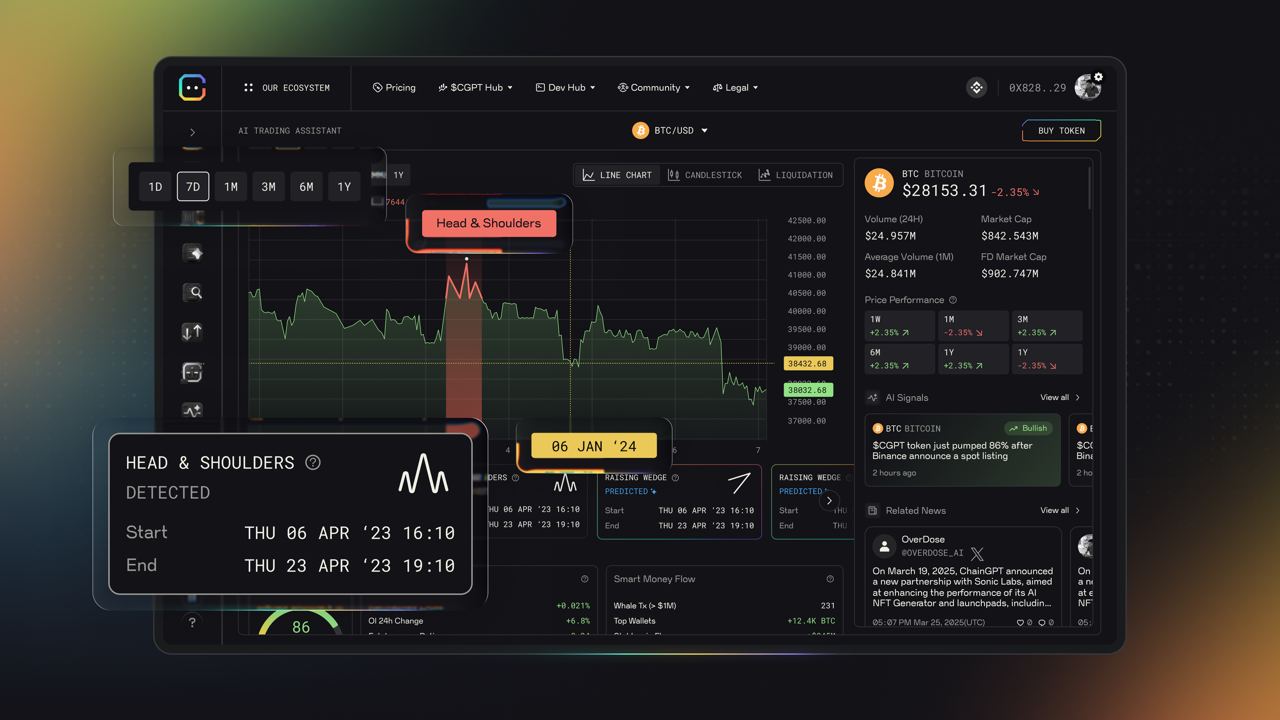
AI trading bots excel at recognizing complex chart patterns like head-and-shoulders, flags, and triangles. More importantly, they quantify the strength of these patterns using volume analysis and momentum indicators. This removes the subjectivity from technical analysis, giving you a clearer signal for entry and exit points.
Beyond price action, AI analyzes on-chain data and social sentiment. It tracks whale movements, exchange inflows, and even news sentiment to gauge market mood. Combining technical patterns with fundamental sentiment creates a more robust trading thesis. This multi-layered approach helps filter out false signals that often trap manual traders.
The following widget shows live data for a major altcoin. Use it to observe how price action correlates with the patterns your AI bot is currently monitoring.
AI doesn't replace your judgment; it augments it. By automating the detection of high-probability setups, you free up mental energy to manage risk and execute trades with precision. The goal is consistency, not perfection.
Setting up your first automated strategy
Connecting an exchange API to an AI trading bot is the bridge between manual effort and automated execution. This process requires precision because you are handing over control of your capital to software. A single misconfigured permission can lead to unintended trades or, worse, unauthorized withdrawals.
We will walk through the standard workflow for connecting your exchange account to a bot platform. This guide focuses on the technical steps required to establish a secure, read-only or trade-enabled link, ensuring your strategy runs exactly as you designed it.
Log in to your primary exchange and navigate to the API management section. Generate a new key pair. Most exchanges will provide a public key and a secret key. The public key identifies your bot; the secret key authenticates it. Treat the secret key like a password—never share it publicly or commit it to public code repositories.

This is the most critical security step. When setting permissions for your new API key, enable "Trade" or "Spot Trading" but disable "Withdrawal." Disabling withdrawals ensures that even if your bot is compromised or malfunctions, the attacker cannot move your funds out of the exchange. Enable "Read" access to allow the bot to monitor your balance and open positions.

Open your chosen AI bot platform and locate the "Exchange Connection" or "API Settings" menu. Paste your Public Key and Secret Key into the designated fields. Most reputable platforms encrypt these keys immediately upon entry. Some platforms may ask you to sign a cryptographic message to prove you own the key; follow the prompt to complete the handshake.

Before deploying real capital, test the connection. If the bot supports a testnet (paper trading), run a simulation first. If not, start with a minimal amount of capital—enough to cover trading fees and slippage but not enough to cause significant financial harm. Watch the bot execute a single trade to confirm it receives market data and submits orders correctly.


As an Amazon Associate, we may earn from qualifying purchases.
Once the connection is verified, you can proceed to configuring your specific trading parameters. Always keep your API keys updated and rotate them periodically if your exchange supports it, maintaining a clean security posture for your automated operations.
Common mistakes that drain bot accounts
Even the most sophisticated AI trading bot will bleed capital if you configure it poorly. Many traders treat bots like "set and forget" money printers, but they are actually complex systems that require active oversight and realistic expectations. When you ignore market structure or force a strategy that doesn't fit current conditions, you aren't trading—you're gambling with code.
Over-optimization and curve-fitting
One of the most expensive errors is curve-fitting: tweaking your bot's parameters so perfectly that it looks brilliant on past data but fails in live markets. When you optimize too many variables against historical data, you create a strategy that memorizes noise rather than learning signal. This works beautifully in backtests but collapses the moment live market volatility shifts slightly.
A robust bot should have few, logical parameters based on market mechanics, not statistical artifacts. If your backtest requires 15 different settings to turn a profit, it is likely broken. Keep your strategy simple and logical. If it can't explain why it takes a trade in plain English, it probably shouldn't trade at all.
Ignoring market regime changes
Crypto markets shift between trending, ranging, and high-volatility regimes constantly. A bot designed for a strong bull market trend will get chopped up in a sideways consolidation phase. Conversely, a mean-reversion bot that works in calm markets can blow up during a flash crash or sudden news event.
Your bot needs to recognize when the market environment has changed. This might mean adjusting stop-loss widths, reducing position sizes, or pausing trading entirely. Relying on a single static strategy across all market conditions is a fast track to liquidation. Regularly review your bot's performance against current market volatility, not just historical averages.
Poor risk management
No amount of AI intelligence can override basic risk management. The biggest mistake traders make is letting their bot risk too much capital on a single trade or allowing it to compound losses without a hard stop. AI can identify patterns, but it cannot predict black swan events or exchange outages.
Always set hard position limits and daily loss limits that the bot cannot override. If your bot is designed to scale in on losing positions (martingale-style), you are inviting a total account wipe. Define your maximum drawdown tolerance and configure your bot to stop trading once that threshold is reached. Protecting your capital is more important than catching the next pump.
Practical configuration checks
Before you launch any bot, run through these specific configuration checks to avoid common pitfalls:
- Limit leverage: Use low leverage (1x-3x) even if your exchange allows more. High leverage amplifies small AI errors into large losses.
- Set max daily loss: Configure a hard stop that halts all trading if the bot loses a certain percentage of your account in one day.
- Test in paper trading: Run your bot in simulation mode for at least two weeks. If it doesn't perform well in paper trading, it won't perform well with real money.
- Monitor volatility: Adjust your bot's sensitivity settings when market volatility (measured by indicators like ATR) spikes significantly above its average.
Compare AI trading bots for your workflow
Choosing the right AI trading bot depends on your specific needs, whether that’s low fees, advanced customization, or ease of use. Below is a comparison of popular platforms to help you decide which fits your strategy.
| Platform | Fee Structure | Supported Exchanges | AI Capabilities |
|---|---|---|---|
| 3Commas | $14–$199/mo | Binance, Coinbase, Kraken | Smart Trade, DCA, Grid Bot |
| Pionex | 0.05% trading fee | Pionex only | 16 built-in bots, no extra cost |
| Cryptohopper | $49–$199/mo | Binance, Coinbase, Kraken | Strategy Designer, Signal Market |
| Bitsgap | $29–$149/mo | Binance, Coinbase, Kraken | Grid Trading, Arbitrage Bot |
Most platforms charge a monthly subscription on top of exchange trading fees. Pionex stands out by including bots for free, though you’re limited to their native exchange. Others like 3Commas and Cryptohopper offer more flexibility by connecting to major exchanges, but require a higher tier plan for advanced AI signals.
When evaluating these tools, prioritize platforms that offer backtesting capabilities. This allows you to verify AI strategies against historical data before risking real capital. Always check the official documentation for each bot to understand their specific risk parameters and data privacy policies.
Frequently asked questions about crypto AI
AI trading bots don't predict the future; they process vast datasets to identify patterns and execute trades faster than humans can. They assist with sentiment analysis and trend identification, but market volatility remains unpredictable.
Can AI predict crypto prices accurately?
No. AI tools analyze historical data and current market sentiment to make data-driven predictions, but they cannot guarantee accuracy. Crypto markets are influenced by unpredictable external factors, making precise price forecasting impossible.
Do I need coding skills to use a crypto bot?
Most modern platforms offer no-code interfaces. You can configure bots using visual templates for strategies like grid trading or DCA (Dollar-Cost Averaging). You simply select parameters like risk level and asset pairs without writing a single line of code.
How do I start with zero experience?
Start with a demo account or a small allocation. Choose a reputable exchange with built-in AI tools, such as Coinbase, to ensure security. Begin with conservative settings to understand how the bot reacts to market movements before scaling up.
No comments yet. Be the first to share your thoughts!